Start With the Database You Already Have
If you already run Postgres or Cosmos DB, the first vector store to try is the one inside it. At a few hundred thousand vectors every option here is fast enough, and one system fewer to operate is worth more than a benchmark win. A dedicated vector database earns its place when scale, filtering or hybrid search outgrow what your database offers.
Choosing a vector database looks like a benchmark question, and mostly it is not. Every product page says fast, scalable and production-ready, and at a few hundred thousand vectors they are all fine. The differences show up later: a small tenant gets empty results because of how filtering works, an import of two million chunks takes the index offline for an afternoon, or you need keyword search for product codes and your database cannot do it.
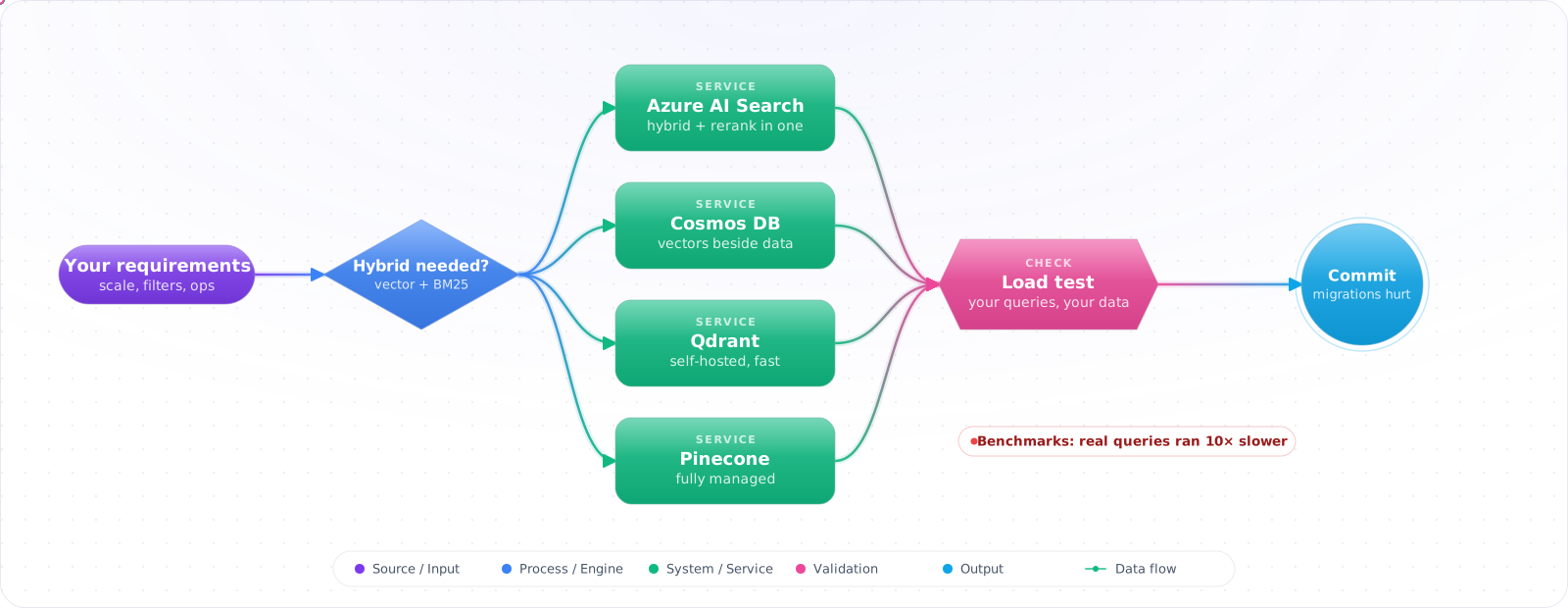
Moving vectors between databases is expensive, because you usually re-embed and rebuild everything. That is the reason to spend a day on this choice up front. Below, Azure AI Search, Cosmos DB, Qdrant and Pinecone are compared on what decides whether you are still happy in a year: how they filter, how they handle updates, whether they do hybrid search, and what they cost to run.
- You're evaluating 5 vector databases and the feature matrices all blur together
- Your prototype works on Pinecone but you're worried about vendor lock-in at scale
- You already have Cosmos DB and wonder if adding vector search there avoids a whole new service
- You picked a vector DB based on benchmarks and now real queries are 10x slower than advertised
How the Options Differ Under the Hood
Vector databases store high-dimensional embeddings and retrieve the most similar ones for a given query vector. The core algorithm is Approximate Nearest Neighbor (ANN) search — trading a small amount of accuracy for massive speed improvements over brute-force comparison.
      flowchart LR
          Q["Query Vector"] --> ANN["ANN Index"]
          ANN --> R1["Result 1 - 0.95 similarity"]
          ANN --> R2["Result 2 - 0.91 similarity"]
          ANN --> R3["Result 3 - 0.87 similarity"]
          ANN --> R4["Result 4 - 0.84 similarity"]

          subgraph Index Types
              HNSW["HNSW - Graph-based"]
              IVF["IVF - Partition-based"]
              FLAT["Flat - Brute force"]
          end

          style Q fill:#4f46e5,color:#fff,stroke:#4338ca
          style HNSW fill:#059669,color:#fff,stroke:#047857
          style IVF fill:#7c3aed,color:#fff,stroke:#6d28d9
The Contenders
For this comparison, I'm focusing on the options you'll realistically evaluate for a production system on Azure:
- Azure AI Search — Microsoft's managed search service with integrated vector search
- Azure Cosmos DB (NoSQL with vector search) — flat, quantizedFlat or DiskANN vector indexes stored alongside the documents in Cosmos DB for NoSQL
- PostgreSQL + pgvector — Vector search extension for PostgreSQL, ideal if you're already running Postgres (it has its own article, so it isn't configured below)
- Qdrant — Purpose-built open-source vector database (self-hosted or Qdrant Cloud)
- Pinecone — Fully managed SaaS vector database
Four Databases, Configured for Real Use
Azure AI Search
Best for: RAG systems that need hybrid search (vector + keyword + semantic ranking) in a single query.
// Index definition with vector search
{
    "name": "documents-index",
    "fields": [
        { "name": "id", "type": "Edm.String", "key": true },
        { "name": "content", "type": "Edm.String", "searchable": true },
        { "name": "title", "type": "Edm.String", "searchable": true },
        {
            "name": "contentVector",
            "type": "Collection(Edm.Single)",
            "searchable": true,
            "dimensions": 1536,
            "vectorSearchProfile": "default-profile"
        }
    ],
    "vectorSearch": {
        "algorithms": [{
            "name": "hnsw-config",
            "kind": "hnsw",
            "hnswParameters": { "m": 4, "efConstruction": 400, "efSearch": 500 }
        }],
        "profiles": [{
            "name": "default-profile",
            "algorithm": "hnsw-config"
        }]
    }
}
Strengths:
- Hybrid search in one call — vector + BM25 + semantic re-ranking
- Built-in skillsets for document cracking, chunking, embedding during indexing
- Integrated with Azure RBAC, Private Link, managed identity
- Semantic ranker significantly improves retrieval quality
Weaknesses:
- Dedicated tiers bill per search unit (replica × partition) by the hour, whether or not you query. The Serverless Developer tier, billed by compute units and storage, is still in preview
- Updates are not transactional with your source data: indexers pull on a schedule (minimum 5 minutes), and push-API uploads land shortly after the write rather than in the same transaction
- Vector fields are capped at 4096 dimensions on every current tier, so check the limits table if you plan to use an unusually wide model
Check it: Run one query that carries both a meaning and an exact term, such as a product name inside a question. A single hybrid call should return passages that match on either. Then look at the bill after a quiet day, because the dedicated tiers charge for the hours and not for the queries.
Azure Cosmos DB with Vector Search
Best for: Applications already using Cosmos DB for operational data, where vector search is one of several access patterns.
// Cosmos DB container with vector indexing policy
// using System.Collections.ObjectModel;
var containerProperties = new ContainerProperties("documents", "/category")
{
    VectorEmbeddingPolicy = new VectorEmbeddingPolicy(new Collection<Embedding>
    {
        new Embedding
        {
            Path = "/contentVector",
            DataType = VectorDataType.Float32,
            DistanceFunction = DistanceFunction.Cosine,
            Dimensions = 1536
        }
    }),
    IndexingPolicy = new IndexingPolicy
    {
        VectorIndexes = new Collection<VectorIndexPath>
        {
            new VectorIndexPath
            {
                Path = "/contentVector",
                Type = VectorIndexType.QuantizedFlat // or DiskANN
            }
        }
    }
};
// Keep the vector out of the regular range index to save RUs on writes
containerProperties.IndexingPolicy.ExcludedPaths.Add(new ExcludedPath { Path = "/contentVector/*" });
Strengths:
- Single database for operational data + vectors — no sync pipeline between databases
- Global distribution and multi-region writes
- DiskANN index type for high-performance vector search at scale
- Transactional consistency — update document and vector atomically
- Billed in request units: serverless accounts pay for RUs consumed, while provisioned accounts (manual or autoscale) pay for the RU/s they reserve
Weaknesses:
- Hybrid search (BM25 + vector via
RRF,VectorDistanceandFullTextScore) needs a full-text policy and index as well as the vector policy, and an existing vector policy or vector index can't be edited in place: you drop and re-create it - Vector search is newer — feature set still evolving
- Need to manage RU allocation for vector search workloads
Check it: Update a document and search for its new content straight away. The vector lives with the document, so the change should be searchable at once, with no sync job in between. Then note what a typical vector query costs in request units.
Qdrant
Best for: Teams that want full control over the vector engine with advanced filtering and payload indexing.
# Qdrant collection with a tenant filter on search
from qdrant_client import QdrantClient
from qdrant_client.models import VectorParams, Distance, Filter, FieldCondition, MatchValue

client = QdrantClient(host="localhost", port=6333)

client.create_collection(
    collection_name="documents",
    vectors_config=VectorParams(size=1536, distance=Distance.COSINE),
    # Qdrant supports payload filtering during vector search
    # This is critical for tenant isolation in multi-tenant RAG
)

# Search with filter (query_points replaces the removed client.search)
results = client.query_points(
    collection_name="documents",
    query=query_embedding,
    query_filter=Filter(
        must=[FieldCondition(key="tenant_id", match=MatchValue(value="acme"))]
    ),
    limit=10
).points
Strengths:
- Excellent filtered search performance (critical for multi-tenant RAG)
- Named vectors — store multiple embedding types per document
- Open source: self-host for cost control, or use Qdrant Cloud
- Rich payload indexing with type support
Weaknesses:
- Self-hosting requires operational expertise (clustering, backups, monitoring)
- No built-in document cracking or enrichment pipeline
- Not an Azure-native service — no managed identity, Private Link requires setup
Check it: Load two tenants of very different sizes and search as the small one. With the filter applied inside the search you should still get a full page of results. This is the test that separates engines on multi-tenant data.
Pinecone
Best for: Teams that want zero operational overhead and are willing to pay for it.
Strengths:
- Fully managed — zero infrastructure to operate
- Serverless pricing option (pay per query)
- Fast onboarding: index and query in minutes
Weaknesses:
- Vendor lock-in: proprietary. The closest thing to self-hosting is BYOC, where Pinecone's data plane runs in your own AWS, GCP or Azure account
- Hybrid search exists (sparse + dense vectors, full-text with dense, or client-side RRF), but you pick and wire up the pattern yourself
- Costs scale aggressively with data size at higher tiers
Check it: Before you commit, export a sample of your vectors and time a full reload. That figure is the real cost of leaving later.
Comparison Matrix
| Criteria | AI Search | Cosmos DB | Qdrant | Pinecone |
|---|---|---|---|---|
| Hybrid search | ✅ Native | ✅ RRF (needs full-text index) | ⚠️ Sparse vectors | ⚠️ Sparse-dense or full-text |
| Semantic re-ranking | ✅ Built-in | ❌ | ❌ | ✅ Hosted rerank models |
| Multi-tenant filtering | ✅ Security filters | ✅ Partition key | ✅ Payload filters | ✅ Namespaces |
| Real-time updates | ⚠️ Near-RT | ✅ Immediate | ✅ Immediate | ✅ Seconds |
| Operational complexity | Low (managed) | Low (managed) | High (self-host) | Very low |
| Billing unit | Search units per hour | RU/s provisioned, or RUs consumed | Your servers, or Qdrant Cloud | Usage-based (serverless) |
| Azure integration | ✅ Native | ✅ Native | ⚠️ Manual | ⚠️ Manual |
Try It on Your Own System This Week
Three things to find out before you compare feature tables, about an hour in total:
- Count your vectors, and how fast the number grows. Under a few hundred thousand, this choice matters much less than the comparisons suggest.
- Write down your three hardest queries. A filtered search for a small tenant, a query with an exact term, and one that must reflect a write made seconds ago. Run those on each candidate, not a benchmark.
- Estimate what leaving would cost. Moving usually means re-embedding and rebuilding everything. Knowing that figure tells you how much care this decision deserves.
Mistakes That Force a Migration
1. Choosing based on benchmarks alone
Synthetic benchmarks (ANN-benchmarks.com) measure raw query speed on static datasets. In production, what matters is: query speed under concurrent load + with metadata filters + during index updates. These numbers are very different from benchmarks.
2. Ignoring the update path
Documents change. If your vector database makes updates expensive (full re-index), you'll accumulate stale data. Cosmos DB and Qdrant handle individual document updates well. AI Search requires indexer re-runs or push-mode updates.
3. Underestimating hybrid search value
Pure vector search misses exact matches. When a user searches for error code "NullReferenceException" or API name "CreateUserAsync", BM25 keyword search is more accurate than semantic similarity. If your queries include specific terms, you need hybrid search.
4. Multi-tenant afterthought
Adding tenant isolation to a vector database after the fact is painful. Design for it from day one: partition keys in Cosmos DB, security filters in AI Search, payload filters in Qdrant, namespaces in Pinecone. Price each option with your own vector count and query rate in the vendor's calculator; list prices change too often to quote here.
How I Would Choose
- Default to Azure AI Search for RAG if you need hybrid search and semantic re-ranking. The retrieval quality advantage is significant.
- Use Cosmos DB when vectors are alongside operational data — avoid building a sync pipeline between your main database and a separate vector store.
- Choose Qdrant for advanced filtering requirements (multi-tenant, complex metadata queries) and when you want infrastructure control.
- Pinecone for rapid prototyping when operational simplicity outweighs cost and lock-in concerns.
- Always prototype with your actual queries. Load 10K real documents, run 100 real queries, and measure precision. The right choice depends on your data, not generic benchmarks.