


Contract Testing Replaces the Worst E2E Tests You've Ever Written
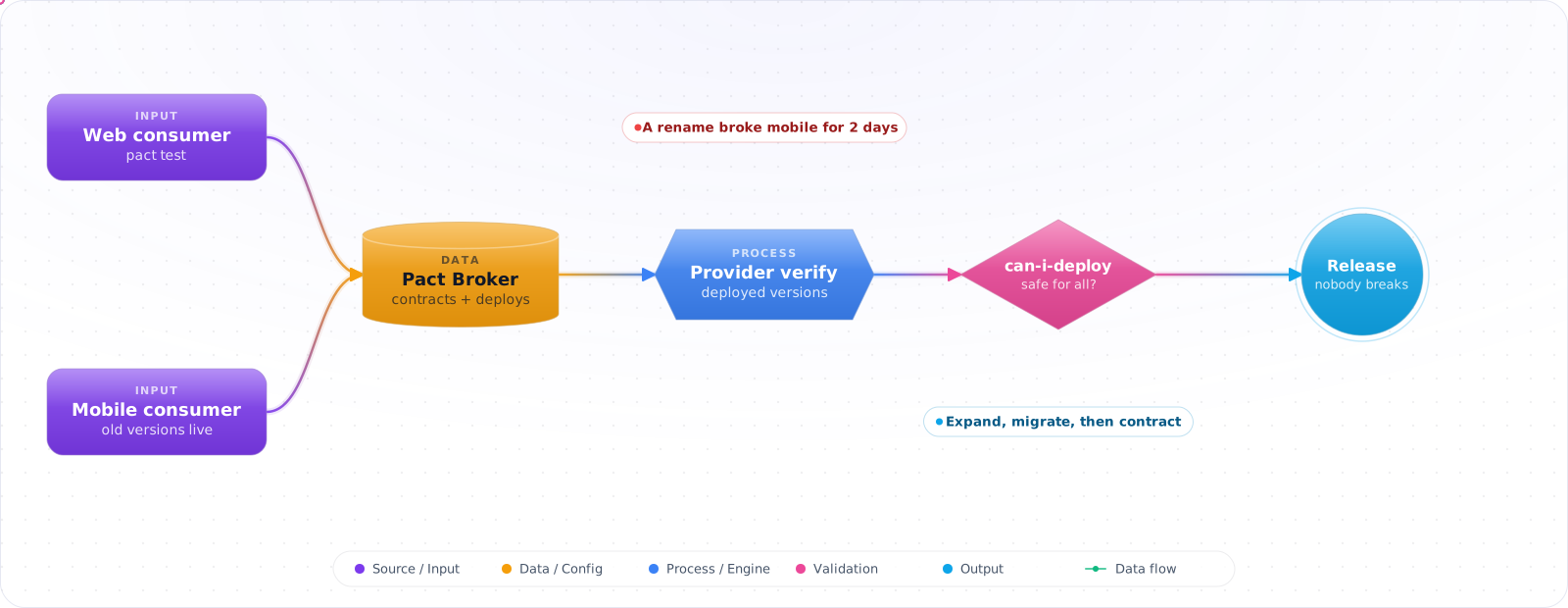
Take a typical case, made up for illustration. An API team renamed deliveryDate to estimatedDelivery. Staging was green, because staging ran the latest mobile build, which had already been updated. Most customers were on an older version of the app, and their order screens showed blanks for two days.
Contract testing catches that kind of break in CI, on each side of the boundary, without a shared environment. Consumers record what they actually use, providers verify it, and a broker knows which versions are deployed where. Below is how Pact works on both sides, the can-i-deploy gate, bidirectional contracts, and where contract testing helps and where it does not.
- Deploying service A breaks service B in production, and your “integration env” missed it
- Teams freeze deploys around release windows to avoid cross-service breakage
- You have a 200-test E2E suite that takes 40 minutes and tells you very little
- API specs drift from reality between versions
Consumer-Driven Contracts with Pact give you the breakage signal early, in CI, on each side of the boundary independently.
How Pact Works
flowchart LR
    subgraph Consumer
      CT[Consumer test<br/>describes expected request/response]
      CT -->|generates| PACT[(pact.json)]
    end
    PACT -->|publish| BROKER[Pact Broker / PactFlow]
    subgraph Provider
      BROKER -->|fetch| PV[Provider verifies<br/>against running service]
      PV -->|results| BROKER
    end
    BROKER -->|can-i-deploy?| DEPLOY[CD pipeline]
The Consumer Side
On the consumer, you write a test against a Pact mock server. The test exercises your real client code; Pact captures every interaction (request + expected response) into a JSON pact file.
import { PactV3, MatchersV3 } from '@pact-foundation/pact';
const { like, eachLike } = MatchersV3;

const provider = new PactV3({
  consumer: 'web-checkout',
  provider: 'orders-api',
  dir: './pacts',
});

it('GET /orders/:id returns an order', async () => {
  await provider
    .given('an order with id 123 exists')
    .uponReceiving('a request for order 123')
    .withRequest({ method: 'GET', path: '/orders/123' })
    .willRespondWith({
      status: 200,
      headers: { 'Content-Type': 'application/json' },
      body: {
        id: like('123'),
        status: 'paid', // exact on purpose: like() would accept any string, and the client depends on this value
        items: eachLike({ sku: 'X', qty: 1, price: 9.99 }),
      },
    })
    .executeTest(async (mock) => {
      const client = new OrdersClient(mock.url);
      const order = await client.getOrder('123');
      expect(order.status).toBe('paid');
    });
});
Notice the matchers: like and eachLike describe shape, not exact values. The contract says “there's a numeric qty”, not “qty is exactly 1”. The provider is free to return any value of the right type.
The Provider Side
The provider runs its real service against the pact file and replays each interaction. Provider states (the given clauses) are set up by handlers that seed the database appropriately before each verification.
import { Verifier } from '@pact-foundation/pact';

await new Verifier({
  provider: 'orders-api',
  providerBaseUrl: 'http://localhost:3000',
  pactBrokerUrl: 'https://pact.example.com',
  publishVerificationResult: true,
  providerVersion: process.env.GIT_SHA,
  consumerVersionSelectors: [
    { mainBranch: true },           // verify against consumers' main
    { deployedOrReleased: true },   // and what's in prod / pre-prod
  ],
  stateHandlers: {
    'an order with id 123 exists': async () =>
      db.orders.insert({ id: '123', status: 'paid', items: [...] }),
  },
}).verifyProvider();
can-i-deploy — The Safety Gate
The Broker tracks which versions of which services are compatible. Before deploying, ask the Broker:
# Consumer CI: publish the contract for this version
pact-broker publish ./pacts --consumer-app-version "$GIT_SHA" --branch "$GIT_BRANCH"

# Provider CI: run verification with result publishing on, so the broker has data

# Block the deploy unless this version is verified against all
# deployed consumers (and provider, if we're the consumer side)
pact-broker can-i-deploy \
  --pacticipant orders-api \
  --version "$GIT_SHA" \
  --to-environment production

# After a successful deploy, record it, or the next gate checks stale data
pact-broker record-deployment \
  --pacticipant orders-api \
  --version "$GIT_SHA" \
  --environment production
This is where contract testing earns its keep — it turns “are these versions compatible” from a judgment call into a yes/no answer from the system. That answer covers the verified contracts only, not business logic, auth, deployment health or consumers without a pact.
Bidirectional Contract Testing
PactFlow's Bi-Directional Contract Testing, launched in 2022 as a PactFlow feature rather than part of open-source Pact, lets the provider use a spec source (OpenAPI doc, generated schema) instead of literally executing the pacts. PactFlow checks consumer expectations against the provider's spec. This is the realistic path when the provider team can't adopt Pact (legacy, vendor, etc.).
When Contract Testing Helps Most
- Microservices owned by different teams with independent deploys.
- Public or partner APIs where you can't coordinate releases.
- Mobile and SPA clients consuming a backend — Pact pacts replace the “we changed the API and broke iOS” surprise.
- Replacing flaky end-to-end happy-path tests that only verify the API contract.
When It Doesn't Help
- Monoliths with one deployable. The CI test suite already covers everything.
- Event-driven systems with complex semantic guarantees (use schema registries + compatibility checks; Pact supports messaging but it's a different model).
- Business workflow correctness — contracts verify the wire format, not the meaning. You still need E2E or end-state tests for that.
What Each Layer Catches
| Layer | Catches | Misses |
|---|---|---|
| Unit | Logic bugs in one component | Interaction bugs |
| Integration | DB / framework wiring | Cross-service contracts |
| Contract | Wire-format breakage between services | Semantic correctness, business flows |
| E2E | Whole-system flows, UI behavior | Slow, flaky, expensive |
Tooling Beyond Pact
- Spring Cloud Contract — Pact-like for the Java/Spring ecosystem.
- OpenAPI + Schemathesis / Dredd — schema-first; consumer-blind but useful if you have a strong API-first culture.
- Buf / Protobuf compatibility — for gRPC, schema evolution checks at compile time.
- JSON Schema + AsyncAPI — for event payloads on a message bus.
Pitfalls
Over-specifying contracts
If the consumer asserts on the exact UUID format, an order ID change breaks the pact even though no real consumer cares. Use matchers liberally. Specify what you depend on; don't snapshot the entire response.
Provider states that drift
Provider state handlers must remain in sync with the consumer's assumptions. When the consumer changes “an order exists” to “an order in state paid exists”, the provider handler must also change. Treat state handlers as part of the API surface.
Ignoring can-i-deploy in CD
Adopting Pact without wiring can-i-deploy into the deploy pipeline gives you most of the cost and little of the benefit. The broker check is what enforces the contract in practice.
Contract Testing and Agents
Pact protects you when a consumer relies on a provider's API, and that now includes AI agents and MCP clients. A tool's schema is a contract. If you rename a field, a human client breaks with an error, and an agent may just behave differently. Diff your tool and OpenAPI schemas in CI with a breaking-change check. Schema diffs catch accidental changes cheaply, while consumer-driven contracts prove that real consumers still work.
Adoption is the hard part of Pact, as both teams must take part. Start with one consumer and one provider where a past incident makes the value obvious. Add can-i-deploy to your pipeline only once the broker has reliable data. Skip Pact entirely when one team owns both sides and they deploy together, because an integration test does the job with less machinery. Bidirectional contracts lower the effort further, by comparing a consumer's expectations with the provider's OpenAPI spec.
Keep Contracts Small
A contract should describe what the consumer actually uses, and nothing else. If a consumer's pact asserts on every field of a response, the provider can't change anything without breaking it, which defeats the purpose. Match on types and only the fields you read. Use Matchers rather than exact values, so that a test doesn't fail because a timestamp changed. Run provider verification on every provider build, not only when a consumer changes.