


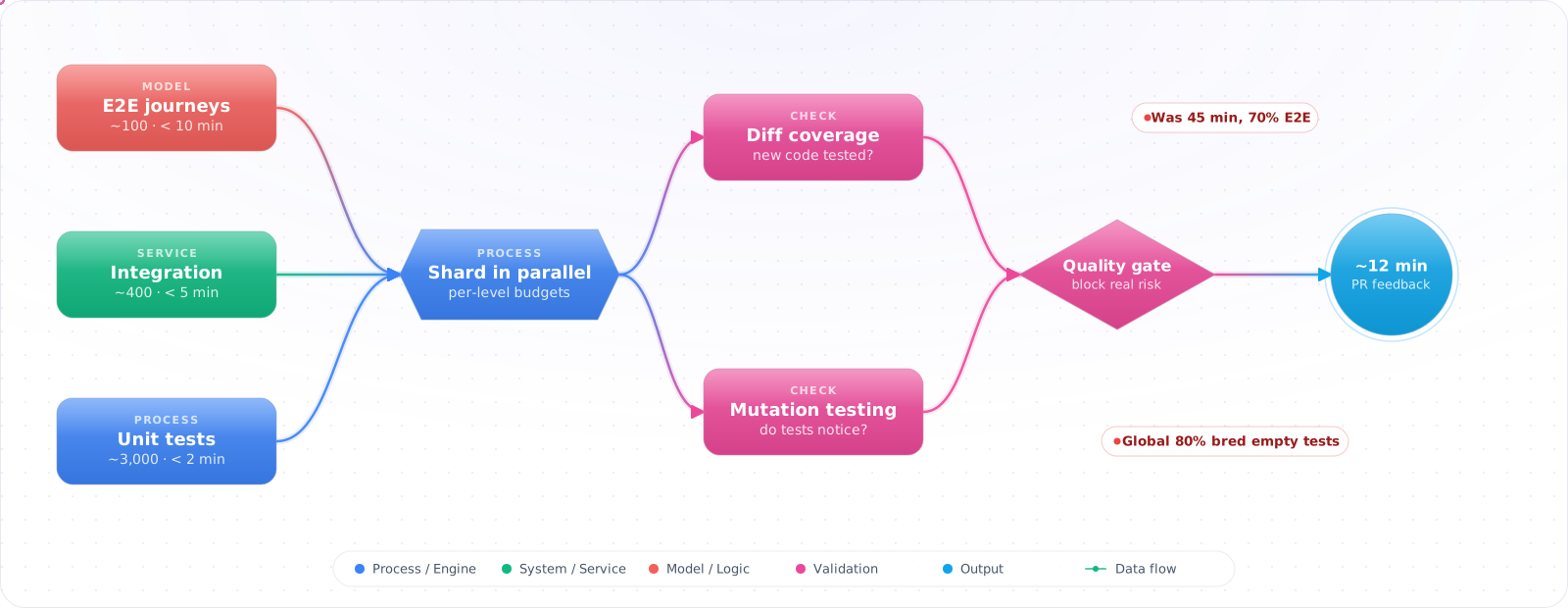
Test Architecture: How Many of Each, and Why
Take a typical case, made up for illustration. Pull requests in one repository waited about 45 minutes for tests, most of it browser tests. Developers started batching changes into big PRs to wait less often. Meanwhile, a global 80% coverage target had produced tests that called code without asserting anything, and nobody could tell which tests actually protected anything.
A test suite has a shape whether you choose it or not. Below is the pyramid and the trophy and which fits which project, coverage that does not lie, a time budget for each level of the pipeline, parallelism and isolation, and the quality gates worth blocking a merge on.
- CI takes 35 minutes and nobody wants to add another test
- You have 400 E2E tests, 50 unit tests, and most prod bugs are still missed
- Coverage is 92% but refactors keep breaking unrelated tests
- Flaky tests are retried automatically and the retry rate is climbing
The architecture decisions you make about your test suite — distribution, isolation, parallelism, what to gate on — drive engineering velocity more than any specific testing framework choice.
The Pyramid
flowchart TB
    E[E2E - few, slow, broad coverage]
    I[Integration - some, medium, real adapters]
    U[Unit - many, fast, narrow]
    E --> I --> U
    style E fill:#fdd
    style I fill:#fed
    style U fill:#dfd
Many fast unit tests at the bottom; fewer integration tests in the middle; a small set of E2E tests covering the most important user journeys at the top. Each level up costs more to write, run and maintain than the one below it.
The Trophy
The testing trophy is a different shape for frontend-heavy apps: a small base of static analysis (TypeScript, ESLint), some unit tests, a large integration body (component tests with React Testing Library), and a thin layer of E2E. The idea: integration tests give the best confidence-per-second for UI work, and TypeScript catches an entire class of bugs that would otherwise need unit tests.
flowchart TB
    E2[E2E]
    INT[Integration - the largest layer]
    UN[Unit]
    SA[Static analysis]
    E2 --> INT --> UN --> SA
    style INT fill:#dfd
Which Shape Fits Which Project
| Project type | Likely shape |
|---|---|
| Domain-heavy backend (banking, billing, logistics) | Pyramid; pure-domain unit tests are gold |
| SPA / frontend | Trophy; component integration tests dominate |
| Microservices | Pyramid + heavy contract testing |
| Glue / orchestration code | Mostly integration; less unit value |
| Data pipelines | Pyramid + golden-output snapshot tests |
Coverage Thresholds That Don't Lie
Past a certain point, chasing line coverage pays back less and starts rewarding weak tests written for coverage's sake. A starting policy to adjust with your own defect data:
- Critical paths (auth, payments, data integrity): high branch coverage plus mutation testing.
- Regular code: 70–80% line coverage is fine if assertions are meaningful.
- Glue / configuration / dead-simple code: don't enforce a number; review and move on.
Mutation testing (Stryker for JS/.NET, Pitest for Java) is the real coverage signal: it mutates code (changes> to >=, removes lines) and runs your tests. Mutants that survive expose weak assertions. Aim for high mutation score on critical paths.
Test Pyramid Math — A Pipeline Budget
Assume you have a 10-minute CI budget. Roughly:
- 5,000 unit tests × ~5 ms each = 25 s. Parallelized across 4 workers, ~10 s.
- 500 integration tests × ~200 ms each = 100 s. Parallelized, ~30 s.
- 30 E2E tests × ~5 s each = 150 s. Sharded across 4 browsers / workers, ~50 s.
- Build + dependency install + framework startup: ~3 minutes.
That's a pipeline of about 5 minutes. At 300 E2E tests instead of 30, the same assumptions give about 12 minutes, already past the budget, and contention usually pushes it higher. These timings are illustrative, so use your own. Treat the E2E count as the most expensive constraint in the suite.
Parallelism and Isolation
flowchart LR
    PR[PR commit] --> CI[CI orchestrator]
    CI --> W1[Worker 1: unit + lint]
    CI --> W2[Worker 2: integration shard A]
    CI --> W3[Worker 3: integration shard B]
    CI --> W4[Worker 4: e2e shard A]
    CI --> W5[Worker 5: e2e shard B]
    W1 & W2 & W3 & W4 & W5 --> GATE[Merge gate]
Run independent layers in parallel. Within a layer, shard by test file or test ID. Each worker needs its own ephemeral resources — DB, cache, fixture data — to avoid cross-test interference.
Quality Gates
Decide what blocks the merge button:
| Layer | Block on? |
|---|---|
| TypeScript / lint / format | Yes, always |
| Unit tests | Yes |
| Integration tests | Yes |
| Contract tests + can-i-deploy | Yes (between services) |
| E2E smoke (3–10 tests) | Yes |
| E2E full suite | On main or nightly, with auto-revert |
| Visual regression | Soft signal; reviewed in PR |
| Performance benchmarks | Soft signal; alert on regressions |
Reducing Flake
- Quantify it. Track first-attempt pass rate per test. Quarantine tests below 95%.
- Eliminate sleeps; use proper waits and fake timers.
- Per-test isolation — fresh DB schema or aggressive truncation, fresh browser context.
- Pin dependencies and toolchain versions; container the runtime.
- One retry on CI for known cosmic-ray flakes; never retry locally — fix it.
CI Pipeline Optimizations
- Run cheapest gates first (lint, types) so PRs fail fast.
- Cache the package install across runs; restore the browser binaries Playwright needs.
- Detect affected modules (Nx affected, Turborepo, change detection) and only run downstream tests.
- Reuse a Docker layer cache; build images once, push by tag, run tests against the artifact.
- Move slow visual regression to a separate workflow that runs on a label or schedule.
The Health Dashboard
A test suite is infrastructure. Treat it like one:
- P50/P95 pipeline duration.
- Flake rate per test, per suite.
- Coverage trend over time (per service / module).
- Top 10 slowest tests — split or optimize them.
- Suite owners — every quarantined test has a person, every old quarantine has a deadline.
Pitfalls
Inverting the pyramid
Hundreds of E2E tests “because they cover everything” results in a slow, flaky suite that no one trusts. Push tests down the pyramid: most of what an E2E catches can be caught by integration tests at a fraction of the cost.
Coverage as a target
Goodhart's law. The moment a coverage number is a target, people write tests that touch lines without asserting anything. Use coverage as a debugging tool, not a KPI.
No owner for the pipeline
If “CI is slow” is everyone's problem, it's no one's. Name a tooling/infra owner with an explicit SLO on pipeline duration and flake rate. It's a real role and a high-leverage one.
Where AI Evals Fit
LLM features add a layer that the classic pyramid doesn't show: evals. They're slower, cost money, and return a score rather than a pass or fail. Keep them apart from your test suite, run a small set on relevant changes, and run the full set nightly.