
Problem Context
"Which model should we use?" gets asked in every team building with LLMs. The answer is usually "it depends," followed by an unhelpful comparison of benchmark scores that don't map to your actual use cases.
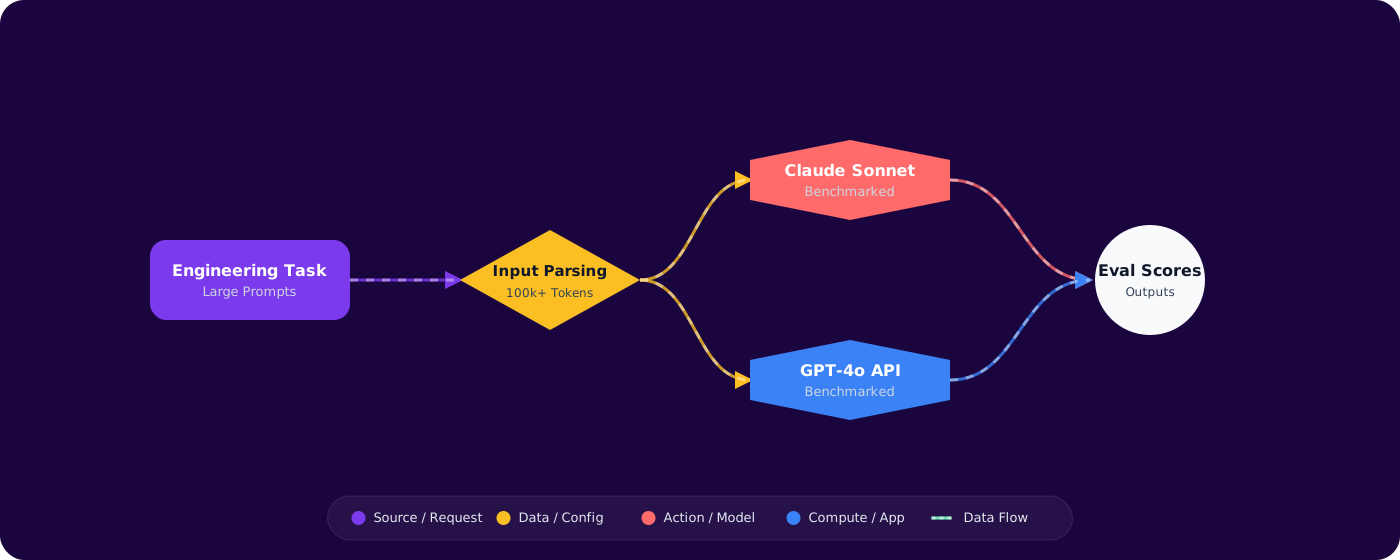
Claude (Anthropic) and GPT (OpenAI) are the two dominant model families for engineering work. They have genuinely different strengths — not in a "one is always better" way, but in ways that matter for specific tasks. Code generation, debugging, architecture analysis, and documentation each favor different capabilities. This article gives you a practical framework for choosing.
- Your team defaults to GPT-4.5 or Claude Sonnet for everything without evaluating alternatives
- You've tried Claude once, got a different result, and aren't sure which was better
- You need to pick a model for a production pipeline and want a data-driven decision
- You're paying for a frontier model on tasks where a cheaper model would work just as well
This article compares the two model families across real engineering tasks so you can make informed choices.
Concept Explanation
Comparing LLMs requires defining what you're comparing on. Benchmark scores (MMLU, HumanEval) tell you about general capability, not about performance on your specific tasks. What matters in practice:
      flowchart TD
          T["Your Task"] --> E["Evaluation Criteria"]
          E --> A["Accuracy\n(correct output)"]
          E --> F["Instruction Following\n(format compliance)"]
          E --> C["Context Handling\n(long input performance)"]
          E --> L["Latency\n(time to first token)"]
          E --> P["Price\n(cost per million tokens)"]

          style T fill:#4f46e5,color:#fff,stroke:#4338ca
          style A fill:#059669,color:#fff,stroke:#047857
          style F fill:#059669,color:#fff,stroke:#047857
          style C fill:#059669,color:#fff,stroke:#047857
          style L fill:#d97706,color:#fff,stroke:#b45309
          style P fill:#d97706,color:#fff,stroke:#b45309
Practical Strengths by Task
Based on real-world usage patterns across production systems and engineering teams:
Code Generation
GPT-4.5 excels at generating idiomatic code in popular languages with common patterns. It's particularly strong at boilerplate, CRUD operations, and standard library usage. Claude Sonnet 4.x / Opus 4 tends to produce more thoughtful code with better error handling and edge case coverage, especially for complex logic. For pure code completion tasks, both are near-equivalent. OpenAI's reasoning models (o3, o4-mini) are worth evaluating for algorithmically hard problems.
Debugging and Code Review
Claude consistently outperforms on debugging tasks that require reading and reasoning about large codebases. Its context window (up to 200K tokens) and strong long-context retention mean it can hold an entire module in context and find cross-file issues. GPT-4.5 is stronger at focused, single-function debugging with a tighter prompt.
Architecture and Design
Claude Opus 4 produces the most nuanced architectural analysis among current models, often identifying trade-offs that others gloss over. It's the go-to for "explain why this is a bad idea" tasks. GPT-4.5 is better at generating specific implementation plans with concrete numbered steps. For deep multi-step reasoning tasks, o3 is worth the extra latency.
Documentation and Explanation
Claude writes more natural, less formulaic documentation. GPT models tend toward repetitive structures ("In this section, we will..."). For API docs and technical writing, Claude Sonnet 4.x produces output that needs the least editing before publishing.
Implementation
Step 1: Define Your Evaluation Matrix
public class ModelEvaluation
      {
          public required string TaskCategory { get; init; }
          public required string TestCase { get; init; }
          public required string ModelId { get; init; }
          public required double AccuracyScore { get; init; }    // 0-1
          public required double FormatScore { get; init; }       // 0-1
          public required double LatencyMs { get; init; }
          public required double CostUsd { get; init; }
          public required int InputTokens { get; init; }
          public required int OutputTokens { get; init; }
      }
Step 2: Build a Comparison Harness
public class ModelComparer
      {
          private readonly Dictionary<string, IChatClient> _clients;

          public async Task<List<ModelEvaluation>> CompareAsync(
              string taskCategory,
              List<TestCase> testCases,
              params string[] modelIds)
          {
              var results = new List<ModelEvaluation>();

              foreach (var testCase in testCases)
              {
                  foreach (var modelId in modelIds)
                  {
                      var client = _clients[modelId];
                      var sw = Stopwatch.StartNew();
                      var response = await client.CompleteAsync(testCase.Messages);
                      sw.Stop();

                      var evaluation = await _scorer.ScoreAsync(
                          testCase, response.Content, taskCategory);

                      results.Add(new ModelEvaluation
                      {
                          TaskCategory = taskCategory,
                          TestCase = testCase.Name,
                          ModelId = modelId,
                          AccuracyScore = evaluation.Accuracy,
                          FormatScore = evaluation.FormatCompliance,
                          LatencyMs = sw.ElapsedMilliseconds,
                          CostUsd = CalculateCost(modelId, response.Usage),
                          InputTokens = response.Usage.InputTokens,
                          OutputTokens = response.Usage.OutputTokens
                      });
                  }
              }

              return results;
          }
      }
Step 3: Model Selection Decision Tree
public string SelectModel(TaskRequirements requirements)
      {
          // Long context tasks → Claude Sonnet 4.5 (200K context, best long-range retention)
          if (requirements.InputTokens > 30_000)
              return "claude-sonnet-4-5";

          // Multi-step reasoning / hard algorithmic problems → o3
          if (requirements.RequiresDeepReasoning)
              return "o3";

          // Strict JSON extraction → GPT-4.5 (best structured output compliance)
          if (requirements.RequiresStructuredOutput)
              return "gpt-4.5";

          // Cost-sensitive with acceptable quality → smaller models
          if (requirements.MaxCostPerCall < 0.01m)
              return "gpt-4o-mini";  // or o4-mini for reasoning-heavy cheap tasks

          // Architecture/deep review tasks → Claude Opus 4 (best trade-off analysis)
          if (requirements.Category is "architecture" or "code-review")
              return "claude-opus-4-5";

          // Default: GPT-4.5 (broadest capability, best OpenAI tooling ecosystem)
          return "gpt-4.5";
      }
Pitfalls
1. Evaluating on benchmarks instead of your tasks
Public benchmarks measure general capability. Your task is specific. A model that scores 5% higher on HumanEval might score 10% lower on your particular code generation task. Always evaluate on representative examples from your actual workload.
2. Comparing across different prompts
GPT and Claude respond differently to the same prompt. A prompt optimized for GPT-4 often underperforms on Claude, and vice versa. For fair comparison, optimize the prompt for each model separately, then compare best-versus-best.
3. Ignoring cost per quality unit
A model that's 5% more accurate but 3x more expensive might not be worth it. Calculate cost per "good result" — total spend divided by the number of outputs that passed your quality threshold.
4. One-model-fits-all
Using a single model for all tasks is convenient but wasteful. Route different task types to different models. Code generation to GPT-4.5, long-context review to Claude Sonnet 4.x, complex reasoning to o3 or o4-mini, simple classification to GPT-4o mini. The routing logic is simple; the savings are significant.
Practical Takeaways
- Evaluate on your tasks, not benchmarks. Build a test suite from your actual workload and compare models against it. What works for HumanEval may not work for your codebase.
- Claude for long context and reasoning, GPT-4.5 for structured output and broad capability. For deep reasoning tasks, also evaluate o3 — the latency cost is often worth it. This is a generalization, but it holds for most engineering tasks.
- Route tasks to the right model. Build a simple model router based on task type, context length, and cost budget. The overhead is minimal; the savings are real.
- Optimize prompts per model. Same task, different prompt. Each model family has different strengths in instruction following — tune accordingly.
- Re-evaluate every quarter. Both families ship major updates frequently — GPT-4.5, o3, Claude Sonnet 4.x, and Opus 4 all landed within months of each other in 2025. Today's winner might not be tomorrow's. Keep your evaluation harness ready to re-run.