Start With Your Text Eval
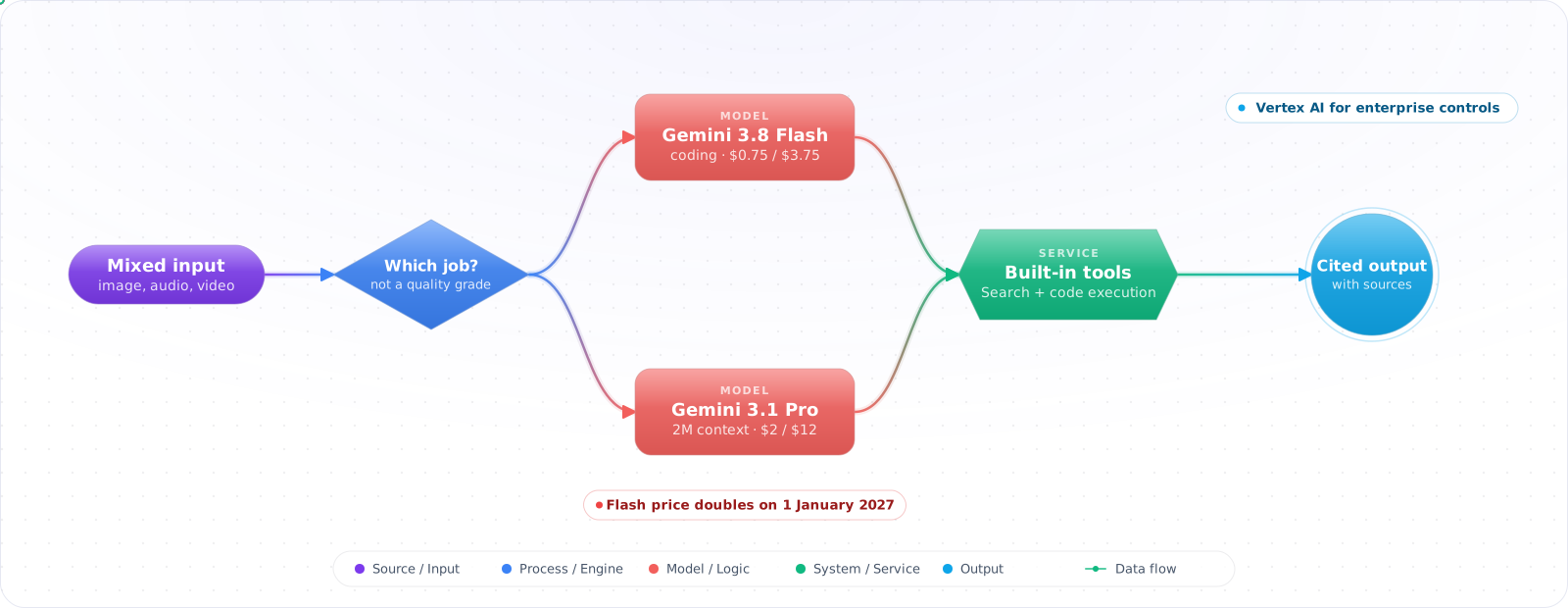
For plain text in and text out, the gap between model families is small, so use whichever wins your own eval. Gemini's particular strengths show when the input is video or audio, when answers depend on current facts, or when you already run on Google Cloud.
Most model families added vision by training a separate image encoder and stitching it onto a text model after the fact. Gemini, out of Google DeepMind, was built the other way: text, image, video, and audio trained together from the start. That distinction sounds like marketing until you hit a task that actually depends on it — asking about what happens across a video clip, not just what a handful of sampled frames show, or feeding in audio directly instead of transcribing it first and losing tone, pauses, and overlapping speech in the process.
- You're transcribing audio with a separate ASR step before it ever reaches the LLM, and losing information doing it
- You need a model to reason over an hour of video and you don't want to build your own frame sampling and captioning step
- You're on GCP already and want IAM, VPC-SC, and data residency handled the way the rest of your stack already handles them
- You keep hitting hallucinated answers on anything time-sensitive and want a model with built-in web grounding instead of building your own retrieval layer for it
What Native Multimodality Unlocks
A model trained jointly across modalities can attend across them in the same forward pass, rather than reasoning over a text description of an image that was generated by a separate captioning step. In practice that means Gemini can watch a video and answer questions about events that unfold over time — not just describe a frame, but track what changed between frames and what the audio track was saying while it happened. Feed it a lecture recording and it can reason about tone and emphasis, not just a flattened transcript. None of this makes Gemini strictly better at every task than a text-first model with a vision adapter bolted on; for pure text reasoning the gap is much smaller and sometimes nonexistent. It matters specifically when the input is genuinely multimodal and the modalities interact.
Check it: Take a clip where the answer depends on what was said and what was shown at the same moment. Ask once with the video itself and once with a transcript, and compare.
Argon, Flash and Flash-Lite: Three Different Jobs
For most of 2026 the naming was backwards: Flash shipped all year while Pro sat at 3.1 under a preview id, so Flash was the stronger model for coding and agents. Gemini 4 Argon, generally available since October 2026, fixed that. Argon is now the stable flagship, 3.8 Flash is the default for most production work, and Flash-Lite is the one priced for throughput. Gemini 3.1 Pro is still served, but only as a preview, and I would not start anything new on it. If you read older advice about a 2M-token Pro window, ignore it: the current models all list about 1M.
| Gemini 4 Argon | Gemini 3.8 Flash | Gemini 3.5 Flash-Lite | |
|---|---|---|---|
| Optimized for | The hardest reasoning and long-context work | Coding, agents, everyday reasoning | High-volume, simple tasks |
| Context window | 1M tokens, unified across input and output | 1M tokens | 1M tokens |
| Max output | 65,536, or up to about 1M with long decode | 65,536 | 65,536 |
| Price per 1M tokens | $2 / $10 until 30 November 2026, then $4 / $20 | $0.75 / $3.75 until it doubles on 1 January 2027 | $0.30 / $2.50 |
Check it: Run your task on Flash before you assume it needs Argon. Then redo the cost sum with the prices that apply after the dated changes.
Grounding With Google Search
Gemini can be configured to ground its answers in live Google Search results before generating a response — a built-in retrieval step you don't have to build yourself. For anything current-events-adjacent (pricing that changed last week, a product that shipped last month, a fact that was true at training time but isn't anymore), grounding meaningfully cuts down hallucination compared to relying on parametric knowledge alone, and the response typically comes back with citations you can surface to the user. It's not a replacement for a domain-specific RAG pipeline over your own private data — grounding only reaches the public web — but for the specific problem of "is this still true," it's a feature worth turning on rather than reimplementing.
from google import genai
from google.genai import types

client = genai.Client()  # reads GEMINI_API_KEY from the environment

response = client.models.generate_content(
    model="gemini-3.8-flash",
    contents="What is the latest stable release of Python?",
    config=types.GenerateContentConfig(
        tools=[types.Tool(google_search=types.GoogleSearch())],  # enables grounding
    ),
)

print(response.text)
# response.candidates[0].grounding_metadata carries the sources used,
# so you can show citations alongside the answer rather than presenting
# it as if it came from the model alone.Check it: Ask about something that changed last month, with grounding off and then on. With it on, the answer should come with citations you can show.
Code Execution as a Built-in Tool
Gemini can also be given a sandboxed code execution tool, so instead of guessing at arithmetic or the output of a small script, it writes and actually runs Python and uses the real result. This closes a specific failure mode that shows up a lot in practice: an LLM confidently getting a multi-step calculation wrong because it's pattern-matching the shape of an answer rather than computing it. For data analysis tasks, unit conversions, or anything with real arithmetic in the loop, enabling code execution is usually a better fix than prompting harder.
Check it: Give it a calculation with several steps, with the tool off and then on, and check both answers by hand.
Vertex AI for the Enterprise
The consumer Gemini API is the fastest path to a prototype. Vertex AI is the path enterprises already on Google Cloud actually ship through, for the same reasons enterprises route through Azure OpenAI instead of the direct OpenAI API: IAM integration instead of a separate API key to manage, VPC Service Controls to restrict access to a service perimeter you configure, regional endpoints for data residency (check where each model and feature actually processes data, since that's separate from storage), and billing that rolls into the GCP account you already reconcile. You give up a small amount of bleeding-edge immediacy — Vertex sometimes trails the consumer API by a short window on brand-new capabilities — in exchange for a deployment story your security team has already approved.
flowchart LR
    Dev["Prototype / hackathon"] --> API["Gemini API
(consumer, API key)"]
    Prod["Production, GCP-native org"] --> Vertex["Vertex AI
(IAM, VPC-SC, regional endpoints)"]

    style API fill:#059669,color:#fff,stroke:#047857
    style Vertex fill:#4f46e5,color:#fff,stroke:#4338ca
1. Prototyping on the consumer API, then hitting a wall in procurement
If there's any chance this ships inside a GCP-native enterprise, build against Vertex AI from early on. Migrating a working integration from the consumer API to Vertex late in a project means re-plumbing auth and re-testing quota, not just swapping an endpoint URL.
2. Treating grounding as a substitute for your own RAG
Grounding reaches the public web. It has no idea about your internal wiki, your ticket history, or last quarter's pricing sheet. Use grounding for "is this current-events fact still true" and your own retrieval pipeline for anything proprietary.
3. Defaulting to Argon when Flash would do
It's tempting to reach for the top-tier model out of habit, especially early in a project when nobody's watching the bill yet. Benchmark Flash on your actual task before assuming you need Argon's reasoning depth, and redo the sums for the prices that change in December and January — a lot of production traffic is more routine than the initial prototype made it feel.
4. Feeding video frame-by-frame out of old habit
If you're still sampling frames and captioning them separately before handing them to the model, you're throwing away the reason native video understanding exists. Send the video directly where the API supports it. The model still samples frames at a set rate, so test fast changes and timestamps, and raise the frame rate if your use case needs it.
Try It on Your Own System This Week
Three checks on a feature built on Gemini, about an hour in total:
- Look for a frame-sampling or transcription step in front of the model. Try sending the media directly, and test fast changes and timestamps.
- Check which questions rely on grounding. Anything about your own data needs your own retrieval.
- Ask where this will finally be deployed. If the answer is an enterprise on Google Cloud, build against Vertex AI now.
Key Takeaways
- Native multimodality matters specifically when modalities interact — video with audio, not just images with captions bolted on afterward.
- Argon and Flash are different jobs, not different quality grades of the same job. Benchmark on your actual task before defaulting to the expensive one.
- Grounding with Search is a real hallucination reducer for current-events queries, and a poor substitute for retrieval over your own private data.
- Vertex AI is the enterprise on-ramp — expect a short lag behind the consumer API in exchange for IAM, VPC-SC, and data residency your security team already trusts.